26 June 2012

Sydney provoking 2030

Why are Melbourne and Sydney regularly declared two of the most liveable cities in the world? Access to education and health, culture, infrastructures, the criteria are numerous. Other criteria are environmental care and sustainable development. And in these fields, Sydney has started the transformation from an old town to a green and sustainable city… a proactive transformation which will soon be an example for any major city around the world.

Political determination
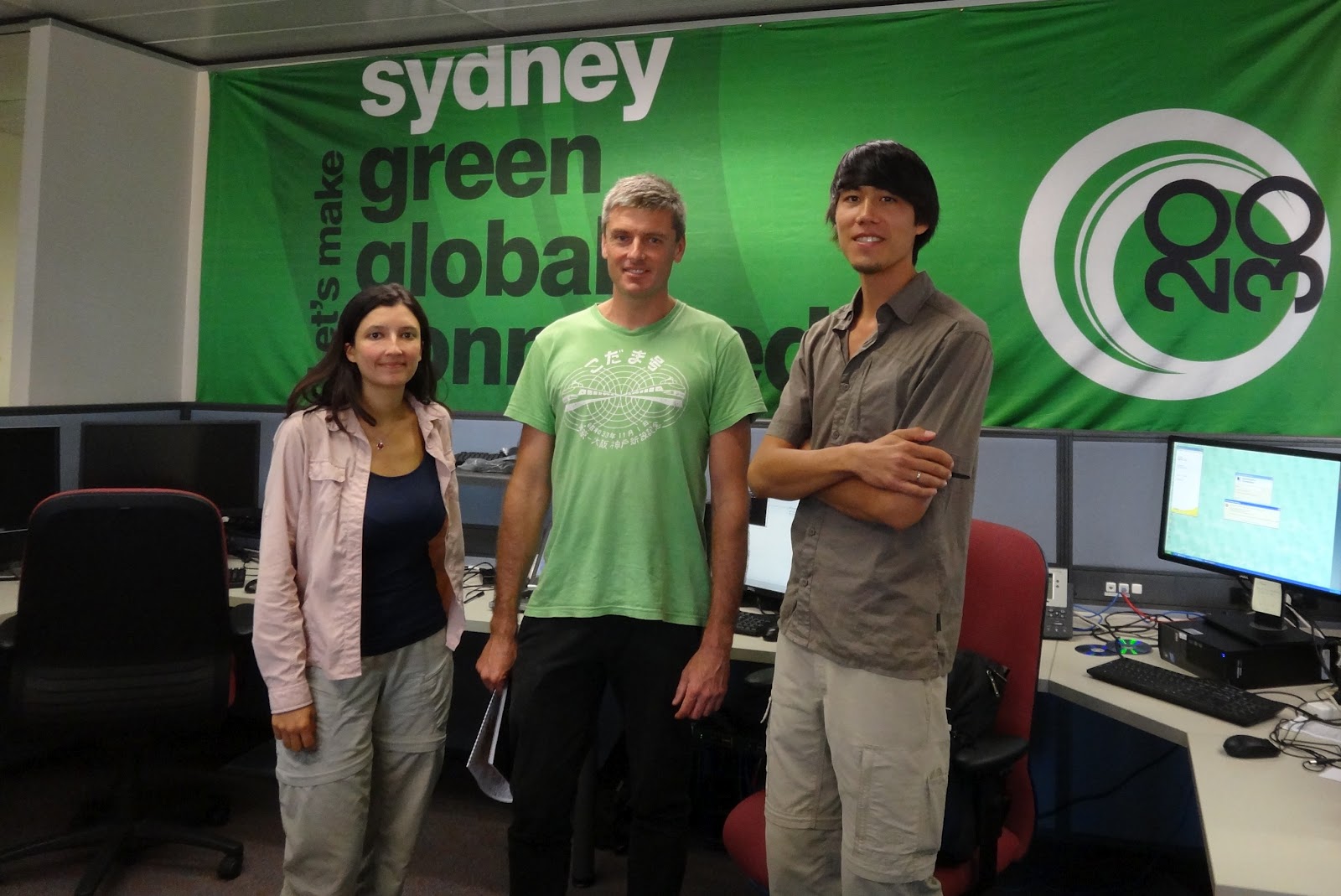
We met Bhakti and Nik on April the 27th,
at Sydney City Hall. On this picture is Nik!
In 2008 the City of Sydney launched the program Sustainable Sydney 2030 and committed the city to becoming a “green, global and connected city”. At the end of April we met Dr. Bhakti Devi and Nik Midlam who work for the City of Sydney as managers defining and implementing the program. Bhakti is managing water strategy and Nik is responsible for carbon strategy. “Around 5 years ago, global context made the climate and carbon emissions issues be in the forefront”, says Nik. Bhakti adds : “the City of Sydney has an old city center, with old systems. It had to be rethought. The ambitious program could start, with the push of Allan Jones who is the leader of the development program and who performed a similar and successful job before in London”.

“A key objective of the program is cutting down the carbon emissions”, Bhakti says. “The City of Sydney has set a target of reducing greenhouse gas emissions by 70% below 2006 levels by 2030”.

A leading environmental performer

Solar panels on the roofs of
Sydney City Hall.
Nik explains : “It is a global transformation that will occur. Concerning the choice of renewable energy, solar energy will be promoted as much as possible. The City of Sydney has the chance to be located in a sunny region”. Bhakti adds : “We are also working on adding a new pipe in the water supply network, a recycled water pipe, which shall be used for flushing for instance. Adding a second pipe in the water networks is a big investment but it will allow saving lots of energy. Today in a building an average 20% of the consumed water is used for flushing! Recycled water should be used instead of drinking water.”

The program sets out a global path for reaching the targets by improving energy efficiency, encouraging people to cycle and walk, utilising waste as a resource, converting non-recyclable waste to energy, recycling water and… implementing a Decentralised Energy Network, powered by Trigeneration.


What is Trigeneration?

The City of Sydney requires approximately 4 million MWh of electricity per year. Traditionally, this electricity has been provided by large, regionally located coal fired power plants. These power plants produce large amounts of electricity, but also produce significant amounts of greenhouse gas emissions. The electricity sector is responsible for approximately half of all Australia’s greenhouse gas emissions as well as approximately 80% of greenhouse gas emissions within the City of Sydney (City of Sydney).

Nik explains : “Trigeneration is the simultaneous production of electricity and the exploitation of waste heat from the generation process to supply heating and hot water needs. In addition, the heat can also be converted into cooling via a heat–driven chiller”. Electricity, heating and cooling…
Trigeneration system (Picture: City of Sydney)
In a first instance, the trigeneration system will burn gas, which is a fossil fuel, and therefore will not provide carbon free electricity. However the system produces far fewer greenhouse gas emissions than the traditional coal fired power stations.

Presentation of trigeneration

Subsequently, renewable gases will be used. “These renewable gases will come from the city waste! They will be created using waste to gas conversion technologies”, says Bhakti. This will displace fossil fuel gas in the trigeneration systems, enabling them to provide carbon free electricity, as well as carbon free thermal energy for heating and cooling…

Nik concludes : “By 2030, the City should have the capacity to meet up to 100 per cent of electricity demand by local electricity generation". A self-sufficient green city… let’s follow Sydney!

City of Sydney Greenhouse Gas Emissions Reduction Target -
B
AU : Business As Usual (Picture: Kinesis 2008)
In addition to the trigeneration system, several changes will allow Sydney to reach their emission reduction target : lighting technology, renewable electricity, transport…


~~~

On the other side of Australia, we met Oscar Arteaga who works as a Senior Engineer for Smart Grid development at Western Power, a State Government owned corporation which operates the electricity network in Western Australia. He explained us that a significant investment is underway to step out of a conventional electricity grid and put into operation a Smart Grid!

What does it mean? A Smart Grid is a more reliable, sustainable and economically efficient electricity network.

More reliable because it uses smart meters and electronic sensors to monitor its performance and increase its ability to repair itself following a system disturbance. All this reduces the frequency and duration of power outages.

More sustainable because consumers actively participate. They can visualize their real-time energy demand to better manage their electricity consumption, especially during peak periods. Consumers and network operators can also control, via the smart meter infrastructure, the operation of major power-consuming devices. Smart Grid can also accommodate many small energy sources, such as on-site renewable energy generation.

More economically efficient because energy providers can have real-time and historical information of their network performance in order to improve network utilisation as well as power reliability and quality.

~~~~~~~~~~~~~~~~~~~~~~~~~~~~~~~~~~~~~~~~~~~~~~~~~~~~~~~~~~~~~~~~~~~~~~~~~~~~~~~~~~~~~~~~~~~~~~~~~~~~~~~~~~~~~~~~~~~~~~~~~

22 May 2012

Earth's inside for better air

Wai-O-Tapu thermal area, Rotorua region.                  The active fault lines along the length 
of New Zealand (green colour), 
where the Pacific and Australian plates meet.
(Picture: NZ Waikato Regional Council)

New Zealand is a volcanic and seismic area. The tragic earthquake of 2010 in the Canterbury region, South Island of the country, was a sad reminder of this. Such an area is also a place where the earth’s interior shows itself at the surface, offering a unique experience of nature…

A natural source of energy

Hot water and steam from deep soils sometimes naturally gather in what is called a geothermal reservoir. A natural reservoir… of energy. Properly processed, this water and steam can be transformed to electricity for instance. These are the basis of geothermal energy.

As the energy is available naturally, it does not require any fuel to process it. This is why very low emissions of greenhouse gases result from the transformation. And this is why geothermal energy is considered as a low-carbon technology, among the low-carbon solutions that humankind must promote.

The Nga-Awa-Purua geothermal
station provides enough
electricity for about 140 000 homes.
“Although few regions in the world are currently undertaking geothermal projects, the potential is huge”, says Jonathon Clearwater. Jonathon works as an engineer at Mighty River Power. The company is a specialist in geothermal development, operating several stations in the North Island of New Zealand.

“Indonesia, Philippines, USA, or Iceland for instance take benefit of their geothermal capacities. Japan also has a lot of potential”, adds Jonathon. In the Philippines, 27% of the electricity comes from geothermal energy.

New Zealand takes advantage of the chance

A geothermal power station.
The extracted water can be
up to 300°C.
(Picture : Mighty River Power)
Jonathon explains : “geothermal electricity generation commenced in 1958 at Wairakei station. At that time, the plant was only the second geothermal plant in the world producing electricity. New Zealand was world leading! Development was slow in the following decades, mainly due to cheap petrol during the 1990s and the early 2000s. But now the technology is back. Expensive oil and global warming have changed the deal.”

“Mighty River Power has the exciting mission to promote this reliable and renewable energy”, Jonathon adds. “Any project is very specific as the technology must adapt to a site which is always unique. It is a case by case task.”


At Kawerau power station, the geothermal energy is not transformed to electricity but is directly used as heat for the nearby paper factory.


The carbon footprint of the electricity production

All electricity generation technologies emit greenhouse gases at some point in their life cycle but some are more environmentally friendly.

Geothermal electricity emits low quantities of greenhouse gases. It means that in order to produce a kilowatt-hour of electricity, few quantities of greenhouse gases are released into the atmosphere. By greenhouse gases we mean the carbon dioxide (CO2) and other gases. The quantity of these other gases is usually measured as gram of equivalent CO2 (g CO2-equivalent).

The unit “g CO2-equivalent per kilowatt-hour” is often used to compare the different technologies. The following comparison chart helps to identify what are the solutions for humankind to produce low-carbon electricity.
In this chart, the emissions of greenhouse gases concern the whole life cycle of the technology:
operation but also construction and maintenance;
the extraction, processing and transport of their fuel (when applicable);
and their decommissioning and disposal.
(Source: UK Parliament 2011 – Compiled by F. Gheung) 

Unfortunately not all regions of the planet allow developing geothermal or hydro-electric energies. Wind and solar solutions, which are subject to climate variations, have lots of potential. It is certain that new solar technologies will be a big part of our future energetic system. Sun sends a huge quantity of energy to Earth and today only a very low percentage of it is used by man. A star for a better air…


We had the chance to meet Jonathon on the 18th of April, at the office of Mighty River Power in Rotorua, located in the middle of New Zealand North Island.


 ~~~
About marine technologies...
At the end of 2011, the French electricity company Electricité de France installed their first marine turbines in the North of France. The installation will bring electricity to around 2000 homes.

Presentation video - in French language


~~~~~~~~~~~~~~~~~~~~~~~~~~~~~~~~~~~~~~~~~~~~~~~~~~~~~~~~~~~~~~~~~~~~~~~~~~~~~~~~~~~~~~~~~~~~~~~~~~~~~~~~~~~~~~~~~~~~~~~~~


12 May 2012

Volunteer for change

Wairau River winery,
in Marlborough region.
   "- They say that in some decades the climate in Finland will be suitable for producing wine!
    - Well, we will see. On the other side, I really hope the weather in France will still be suitable for cultivating grapes!"

France sees its wine production changing slowly. Today the grape-picking is performed three weeks earlier compared to 1945. Climate change definitely has something to do with it. New Zealand is also one of these places where excellent wines are produced…

The carbon footprint of the industry

The winery Wairau River, in New Zealand South Island, is a family run business. Since 2007 the winery has been carbon neutral. What does this mean? The activity of any company generates greenhouse gas (GHG) emissions, which contribute to climate change. To be carbon neutral means to cancel (or offset) these emissions, by avoiding other emissions somewhere else on the planet. For instance saving trees or using renewable energies avoiding GHG emissions.
 
Wairau River has implemented
several actions to reduce their
emissions: producing lighter
and smaller glass bottles
which use smaller cardboard
cartons, allowing the shipping of
more cases per container;
acquiring new fuel efficient
tractors; replacing helicopters,
used for frost prevention,
with wind machines.
On a voluntary basis, companies can decide to offset their emissions. Doing this, they can declare that they do not contribute to the on-going global warming.

In 2007 Wairau River winery decided to measure, reduce and offset its unavoidable emissions of greenhouse gases. This initiative allowed them to obtain the carboNZero certification. The offsetting is done through the investment in wind energy projects. Each ton of carbon costs around 25 US dollars.

Certified… concerned

In order to know about carboNZero certification we went to the office of the company. Ann Smith, General Manager, and Chris Thurston, Sales Executive, explained to us a bit more.

Ann has been working on the certification programme from its very beginning. She explains : “the carboNZero programme results from a research initiative by the New Zealand government, initiated in the early 2000’s. Initially the research programme was interested in restoring biodiversity in New Zealand. To achieve this goal they used unproductive land to regenerate forest. Later on it went further and the programme started to offer financial compensation to farmers so that they would stop using the land for cattle grazing, and continue to regenerate forest. This was the beginning of a carbon trade system in New Zealand.”

Together with Alan Carnaby, Marketing Advisor,
and Chris Thurston,
in the office of carboNZero, in Auckland.
Since then, and with the support of the private sector, it has evolved to become an internationally accredited greenhouse gas certification programme, offering two certification options for businesses.

“In 2009 the carboNZero certification was complemented with the CEMARS (Certified Emissions Measurement And Reduction Scheme) certification with the objective of covering larger companies”, says Chris. “CEMARS certification does not include the offset step of carboNZero certification, but still requires companies to measure and reduce their emissions the same as carboNZero certification. CEMARS certification is suited to larger organisations where offsetting is not really financially viable, but allows companies to understand their impact on the environment and help them work to reduce that impact.”

carboNZero certification:
Businesses must measure, manage and reduce,
and offset their greenhouse gas emissions.
CEMARS certification:
Businesses must measure, manage and
reduce their greenhouse gas emissions
The path to the low-carbon economy

Besides wineries, many other organisations are finding benefits from achieving certification. When we were at Christchurch airport, we could also see the carboNZero certified organisation logo : in January 2008, the airport became the first airport in the Southern Hemisphere to obtain certified carbon neutral status. To help decrease their GHG emissions, the airport implemented innovative paving techniques and used solar energy.

In Wellington, the carboNZero certified service logo can be found on the city’s taxis. The taxi company reduced their emissions by turning from petrol to more eco-friendly fuel options, by ensuring low emission vehicles to enter the fleet and by promoting fuel-efficient driving practices to the drivers.

Other companies that are carboNZero certified include Toyota New Zealand, Bridgestone NZ, Antipodes (a water company) and Ricoh NZ. Westpac NZ Bank, BMW NZ, New Zealand Rugby Union, Auckland Museum and the University of Canterbury are CEMARS certified.

Besides the potential economic benefits - for instance by being more energy efficient - these companies acquire a better image for consumers who demand eco-friendly products and services. 

New Zealand provides a good example of how the private sector can go faster than legislation. United Kingdom, Australia and New Zealand have established themselves as leaders to promote carbon policies in private sector.

Nowadays more and more airlines, like Qantas, Air France or Easy Jet, offer their customers the opportunity to offset the GHG emissions from their flights at a reasonable cost. Another way to offset is by buying the service of a specialized company. One Climate One Challenge project has offset the emissions resulting from the flights with EMCO2 Solution.


~~~~~~~~~~~~~~~~~~~~~~~~~~~~~~~~~~~~~~~~~~~~~~~~~~~~~~~~~~~~~~~~~~~~~~~~~~~~~~~~~~~~~~~~~~~~~~~~~~~~~~~~~~~~~~~~~~~~~~~~~


24 April 2012

Winds and chaos

Yesterday, in a kitchen in Washington D.C. :
  - Michele : “My Dear, do you know that last March has been the hottest month of March in the U.S. since 1895 ?! I do not like these heat waves. Can’t the scientists predict them?”
  - Barack : “Oh Dear, climate is complicated, it is very difficult to predict. And concerning the heat waves, unfortunately global warming will mean more of them!…”

Chaos in the air 

For the scientists dealing with climate change, the forecast of the climate in the next decades is a key item. Models build these predictions. They show trends however no one can declare they are perfectly accurate. Why? Because the climate is an extremely complex system and humans have been studying it for only few decades.

We met Christophe in Nouméa 
on the 16th of April. In the past 
Christophe worked in the 
United States and Ivory Coast.
“The weather here in the Pacific Ocean is even less predictable than in the Atlantic Ocean for instance”, says Christopke Menkes. We met Christophe Menkes in Nouméa, New Caledonia, at the Institute of Research for Development (Institut de Recherche pour le Développement, IRD) which is a French governmental organization dedicated to research, outside of metropolitan France. Christophe is an expert in oceanology and focuses especially on cyclones, environmental impacts on tuna, and climate effects on Dengue spreading.

Christophe explains : “When dealing with climate predictions, there is a part of variability that cannot be reduced. The chaos theory explains this : many conditions influence the climate and very slight changes of these conditions can totally modify the consequences.” Maybe you have heard about the butterfly effect? 'A butterfly wing flapping in Japan might be the origin of a cyclone in the United States!'

From winds to cyclones 

Christophe adds : “For instance, about cyclones, specific winds of West Africa are always at the origin of the Atlantic cyclones. It is what we call a forcing input. In South West Pacific, the conditions are more complex and more random”.
The tropical cyclones, between 1945 and 2006 -
The area in South West Pacific where the cyclones are generated extends from the Solomon Islands to Tonga. New Caledonia is located in the middle of this cyclonic region.
“Concerning the cyclonic activity in the South West Pacific region, studies say that global warming will not necessarily mean an increase in numbers of cyclones. Regarding their intensity, only two studies have been published so far and they predict that the cyclones will be more intense in this region. The question should be more investigated to give solid conclusions”, says Christophe.

“Regarding the Central Pacific, things are clearer. The phenomenon El Niño has a direct impact on the generation of cyclones.” The El Niño episodes are defined as warmer than normal sea-surface temperatures in the tropical Pacific Ocean. “The more El Niño occurs, the more cyclones will emerge ; and the studies show that climate change is the origin of more and more periods of El Niño.”

Irene, Katrina, Rita… nice names which worry North East America

Concerning the Atlantic, there is observational evidence of an increase in intense tropical cyclone activity in the North Atlantic since about 1970. “In some cases natural variability of the climate can result in an extreme event being more intense on a long period. However in the North Atlantic the recent change is a consequence of human activity,” says Christophe.

The cyclone (or hurricane) Katrina of 2005 was one of the most destructive and expensive natural disaster in U.S. history. It claimed 1 800 lives and caused 134 billion dollars in damage (U.S. Global Change Research Program, 2009). We also remember that last year Irene forced New York City to stand still during some days and be partially evacuated. The Big Apple will probably experience these circumstances again in the future.


Land lost during 2005 Hurricanes - 
In 2005, in the United States, 560 km² of land and wetlands were lost to open water during hurricanes Rita and Katrina. The photos and maps show the Chandeleur Islands, east of New Orleans, before and after the 2005 hurricanes ; 85 percent of the islands’ above-water land mass was eliminated (U.S. Global Change Research Program, 2009).


At end of March, the Intergovernmental Panel on Climate Change (IPCC) published a special report about extreme events, called Managing the Risks of Extreme Events and Disasters to Advance Climate Change Adaptation. The report assesses the evidence that climate change has led to changes in climate extremes – cyclones, droughts, floods, heat waves - and the extent to which policies to avoid these prepare for, respond to and recover from the risks of disaster can reduce the impact of such events. Regarding cyclones, the conclusions are the following : “first, it is likely that the global frequency of tropical cyclones will either decrease or remain essentially unchanged. Second, average tropical cyclone maximum wind speed is likely to increase, although increases may not occur in all ocean basins.”
~~~

Presentation video of the special report by the IPCC. The report can be downloaded here.


~~~~~~~~~~~~~~~~~~~~~~~~~~~~~~~~~~~~~~~~~~~~~~~~~~~~~~~~~~~~~~~~~~~~~~~~~~~~~~~~~~~~~~~~~~~~~~~~~~~~~~~~~~~~~~~~~~~~~~~~~


31 March 2012

French Polynesia looking ahead

We met Jacky Bryant on the 
21st of February at the 
Ministry of Environment, 
in Papeete, Tahiti island.
“An opportunity for humankind to rethink”. These words from Jacky Bryant, Minister of Environment of French Polynesia, show a pretty distinctive idea about climate change. And we liked to hear this from someone with such responsibilities!

A Plan on Climate Change, for the whole society to think sustainable

As with most of the countries in the Pacific, the overseas country of the French Republic (Pays d'Outre-Mer) has a high vulnerability with regard to climate change. French Polynesia is composed of several archipelagos, with small and mostly low altitude islands, and where sea level rise and cyclones are ones of the greatest threats.

When we met Jacky Bryant at end of February, he and his team were preparing a significant two-months task : several workshops taking place during March and April, with the final objective to draft a Strategic Plan on Climate Change (Plan Climat Stratégique). Each workshop deals with a specific sector and gathers the corresponding local socio-economic actors : transport, urbanism, energy, ecosystems, etc. The main purpose of the Strategic Plan is to issue recommendations and guidelines for a global sustainable development of the country. It will be adopted as a national development policy and taken into account on other government programs.


French Polynesia is made up of 5 groups of islands : the Society Islands, the Tuamotu Islands, the Gambier Islands, the Marquesas Islands and the Austral Islands.
(Picture : GNU Free Documentation License)


Prized seas

When we asked the Minister how French Polynesia makes its voice heard during international discussions about climate change, he replied : “French Polynesia lies on a 5 million square kilometers maritime surface. This is larger than the whole European Union. The natural resources are numerous, but here you will have to look below the ocean to see them! For instance, the undersea grounds contain lots of rare earths, which are nowadays the subjects of strong economic and strategic interests.”

Rare earth properties and uses table. 
(Picture : Geoscience Australia)
The rare earths contain the elements required in the manufacturing of our mobiles phones, TVs, other electronic equipments and also green-energy technologies. Today China produces more than 90 per cent of the world's supply but takes advantage of this position. Recently European Union, USA and Japan have launched a joint complaint against China before the World Trade Organization, denouncing China's limits on its exports of rare earth metals.

“Another example is the fish resources”, Jacky Bryant adds. “There is an area north of our Tuamotu archipelago where tuna reproduce. The huge quantities of tuna in this area make it very valuable and fishermen from all over the world would like to come and fish there.

We do not mean that we want these resources to be exploited. We are just saying that French Polynesia is not only some ‘rocks floating in the middle of the Pacific’. If these resources are to be exploited one day, it must be in a very sustainable way.”

Jacky Bryant comments : “Chinese and Russians for instance understood the values of the Pacific waters. This is why they have started to invest in some countries, without any compensation, building stadiums for free for example. Long term investments to ensure them a position in the Pacific…”

Climate change and… education

Drivers of change in small islands and 
the implications for island condition 
and well-being under no adaptation 
and the near-term and mid-term 
implementation of adaptation. 
[IPCC 2007 Report, adapted from 
Harvey et al. (2004)]
 “We know that climate change will result in several kinds of difficulties in the future. And we try to get ready for that”, says the Minister. “For instance, we have in mind which islands could be the destination of a possible migration of people, due to sea level rise. This destination would be the Marquesas Islands, North East of French Polynesia. These islands have higher altitude lands and lots of these lands still belong to the State.”

Jacky Bryant adds : “I am convinced that the future changes represent also an opportunity to correct and to re-think. Lots of components of our society have to be rethought. Sustainable development must be part of all actions and changes should also be the occasion to improve. Let’s take the example of tourism in French Polynesia : today we offer mainly seaside tourism, tomorrow we should also promote a cultural tourism”.

This temple, called marae, is part
of the archeological heritage
of the Moorea
island.
Surprisingly it is located in the
middle of a private property,
which was bought some years ago
by an American.
The tourism is the first economic sector of the country and represents around 25% of local gross domestic product (IEOM, 2008). Nevertheless French Polynesia is mainly a seaside tourism destination. It is often associated to white sand beaches and turquoise waters! The Minister explains : “There is a strong archeological heritage to protect and promote. This is why I am in favor of creating a university diploma in archeology, which for the moment does not exist here. Our cultural and heritage sites are located in coastal areas. On the one side, climate change will have an impact on the seaside tourism and on the other side, it will imply adapting the coastal infrastructures : French Polynesia needs qualified people to control and go along with it!”


~~~

In a previous article, we mentioned that Maldives is trying to buy land in Sri Lanka and India as anticipation to possible relocation of the population due to sea level rise. Recently Anote Tong, President of the Kiribati in Central Pacific, recognized that there is an ongoing discussion with the government of Fiji, in order to buy land there. Kiribati has already started to see its coasts taken by the waters, mainly due to sea level rise and erosion, and has no other choice but to prepare a migration of its entire population, 113 000 people.
 ~~~

Journalists followed us while we met Jacky Bryant end of February. This is the news report, by the French Polynesia TV channel TNTV.


~~~~~~~~~~~~~~~~~~~~~~~~~~~~~~~~~~~~~~~~~~~~~~~~~~~~~~~~~~~~~~~~~~~~~~~~~~~~~~~~~~~~~~~~~~~~~~~~~~~~~~~~~~~~~~~~~~~~~~~~~


13 March 2012

Planet Rapa Nui

This is the story of a prosperous civilization which consumed without control the resources of their place, to such a point that these resources nearly disappeared, conflicts between people popped up and the civilization lost its greatness. Are we talking about human civilization on Earth today? Near future will tell us how things will evolve, but let’s see here what happened to the inhabitants of Easter Island, the small island in the Pacific, in the middle of last millennium.

Symbolic Moais

Rapa Nui is the name of Easter Island in local Polynesian language. Jacob Roggeveen (1659-1729) reached the island in 1722, the day of Easter - thus the name - and while exploring the island, the Dutch navigator could observe what is today the symbol of the island : the moais. The moais are huge megalithic figures representing the ancestors of the island clans. They were carved from the volcanic rock of the island, and then transported to their final place somewhere on the coast. The erected ones can be up to 10 meters high and weight 86 tons. They all look towards inside the island.

The first residents settled on the island in a period that is not clearly defined, due to few data available ; this period is between 400 AD and 700 AD. The explorers came from west, from the Marquesas islands in nowadays French Polynesia. At that time the island was the home of one of the highest palm trees on Earth and of several bird species. From then, the population adapted to the environment and rose slowly. Between 900 and 1300 the human population of the prosperous society started to increase more rapidly, reaching possibly 15 000 inhabitants. Also during this period more and more moais were erected by the different clans of the island.

Easter Island is a volcanic island. It lies 3 500km west of continental Chile

From around 1300 the Rapa Nui people started to face an issue : the number of trees, which represented a key resource, turned to be insufficient! Three main causes explain this slow disappearance of the trees.

Tree lessons

Firstly, the islanders had developed much technology - not only related to the wood - and trees were used a lot during everyday life by the growing population. They were used to build boats or to transport the moais for instance. Actually the moais turned to be the subject of a competition between the clans. Higher and higher, bigger and bigger. More and more wood was cut to displace the moais. The problem is that the Polynesian cut the trees without control and did not replant. They over-consumed the resource and forgot about the day after. This can be lesson number one : the resources are rarely unlimited, and today human being is over-consuming the natural resources of the planet.

The scientists or the historians are not certain about which technology was used to transport the moais. Nevertheless, whatever the technology, wood and cordage was employed. (Pictures : P. Pavel)
Secondly, a forest can be fragile. As more and more trees were cut, the whole ecosystem became poorer to such a point that the forest collapsed by itself. This is close to the concept of tipping point that we mentioned in a previous article. The Rapa Nui people did not cut the last tree! The forest turned to be more and more fragile, damaging also the soils and the fauna. This can be a lesson number two : nature is fragile, humankind should stop to overuse and must anticipate. Scientists talk about a risk of runaway climate change : the situation could reach a point from where changes will accelerate and will be irreversible.

Thirdly, a proliferation of rats could also explain the loss of the trees. The rats eating the seeds and the roots prevented the proper development of the forest. This can also be a lesson : the invasive species can be a threat for the local environment. The recent abrupt climate changes on Earth promote these invasions. Large flooding, droughts or forest fires allow new species to settle and potentially disturb. For instance global warming could bring malaria back in Europe in the next decades.

The end of an era

During 17th century, the consequences of the loss of the trees became critical on Easter Island. The islanders adapted to it but the trees were vital to the society. Population went down. Famine came, but also cannibalism. Conflicts between the clans appeared and some historians even talk about wars. The clans started to pull down the moais of the adverse clans and there is actually not a single moai that was not brought down. Still today lots of the moais of Easter Island are down. The Rapa Nui people carved around 900 moais but less than 300 were transported to their final place on the coast. Most probably due to the lack of wood.

Some moai have a pukao on their heads. The pukao is a kind of hat and is made
of a specific volcanic rock. On the right, a pukao in front of fallen moais.

“Easter Island is a laboratory where you can observe how men used, destroyed and adapted!” This is one of the first things Sonia Haoa told us. Sonia has been an archeologist working on Easter Island for 35 years and particularly she has an excellent knowledge about the use of the stones by the Rapa Nui people. 

“I do not like to say that what happened was a brutal collapse, because it took time for the forest to disappear. It was more like a slow and tough adaptation to a poorer environment… the end of an era for the Rapa Nui people”, says Sonia. “The islanders were isolated from the rest of the world. This island was their small planet!" Sonia adds : "they have always showed a great capacity of adaptation to the fragile environment of the island. For instance after the loss of the forest, they understood that they had to pay even more attention to their soils, and they turned to be remarkable managers of stone gardens. Stone was available in great quantities on the island, and they successfully used it in order to improve yield.”


In the garden of her office Sonia replanted Toromiro which is an endemic species to Easter Island. The plant once disappeared entirely from the island but was kept in a botanical garden in Sweden.
We met Sonia on February the 15th.


The other Earth… that we do not have

“Today men lost the contact with the nature and the resources. So many people do not know where the food or the goods they buy come from. People lost their ability to observe”, Sonia adds.
  
Nowadays human society consumes lots of natural resources without control and without anticipation. The experience of Rapa Nui can be related to the current excessive deforestations that occur all around the world, releasing huge quantities of carbon dioxide and impacting the water availability for instance. We can also mention the example of bluefin tuna overfishing in the Mediterranean Sea. So many bluefin tuna is caught that it could disappear from this sea in the next years. 

Sonia comments : “how is it that humankind does not react though we are aware of the ongoing change and the resulting risks? Today information is available, technology is also available!” According to the World Wildlife Fund (WWF), if human beings do not change their relation to the natural resources, humanity will need a second planet Earth by 2030. Another planet that we do not have.

~~~~~~~~~~~~~~~~~~~~~~~~~~~~~~~~~~~~~~~~~~~~~~~~~~~~~~~~~~~~~~~~~~~~~~~~~~~~~~~~~~~~~~~~~~~~~~~~~~~~~~~~~~~~~~~~~~~~~~~~~